

Withholding Tax: Why Your Monthly TEJ Filings Get Rejected (and How to Avoid It)
Unlike the Employer Declaration or the Annual Tax Return, which are filed once a year, withholding tax declarations must be submitted every month. This monthly frequency changes the nature of the risk: a recurring mistake is no longer an isolated incident. It becomes a habit that costs valuable time every filing cycle.
At Key Software, we help more than 70 Tunisian companies prepare their tax declarations. By analyzing TEJ, filing rejections experienced by our clients, we have identified three recurring causes, all of which can be prevented before submission.
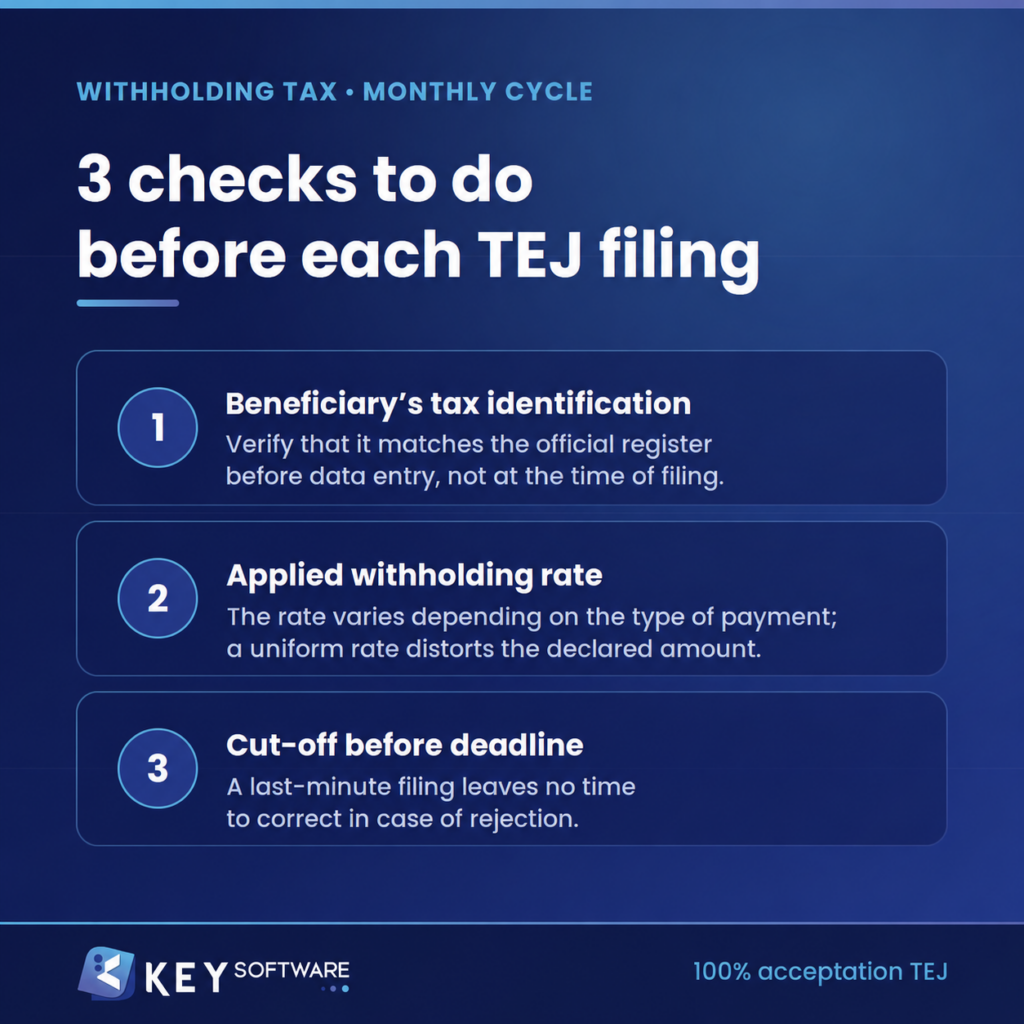
1. Mismatch Between the Beneficiary’s Tax Identification Number and Official Records
A withholding tax declaration often includes multiple beneficiaries (suppliers, contractors, service providers, etc.). A mistyped tax identification number, an incorrect check character, or an outdated identifier that no longer matches the official registry is enough to cause a rejection for that entry. In some cases, only specific records are rejected while the rest of the file is accepted, making the issue difficult to detect afterward.
Best practice: Validate each beneficiary’s tax identification number when the data is entered, not at the time of submission. Performing format and consistency checks upfront eliminates the need to investigate partial rejections later.
2. Applying the Wrong Withholding Tax Rate
The applicable withholding tax rate depends on the type of transaction and, in some cases, on the beneficiary’s tax status. A common mistake is applying a single rate to payments that actually belong to different tax categories, resulting in incorrect declared amounts even when all other information is accurate.
Best practice: Classify payments by category as soon as they are recorded in your accounting system, allowing the correct withholding tax rate to be assigned automatically instead of being reviewed manually every month.
3. Waiting Until the Last Minute to File
Monthly deadlines often create a false sense of routine. Because another deadline is always around the corner, preparation is frequently postponed until the final days. If TEJ rejects the submission, there may be insufficient time to correct the errors and resubmit before the deadline, potentially leading to late penalties or, at the very least, unexpected delays in validation and correction.
Best practice: Treat monthly filing as a continuous process instead of a last minute task. Prepare data throughout the month, perform validation checks before the deadline, and keep a few days of buffer for any necessary corrections.
What This Means in Practice
These three issues have one thing in common. They can all be detected before submission if your data is properly structured and validated in advance. This is exactly the approach behind Key Software’s solutions. Built in validation rules check data formats and consistency before files are generated, preventing most errors from ever reaching the TEJ platform.
The result: a 100% acceptance rate for the filings submitted by our clients. The few rejections we have encountered have always been caused by client-side data issues, never by transmission problems or file format errors generated by our software.
If your company submits withholding tax declarations every month, structuring this process once will significantly reduce stress and save time at every future filing deadline.
 Next Post